
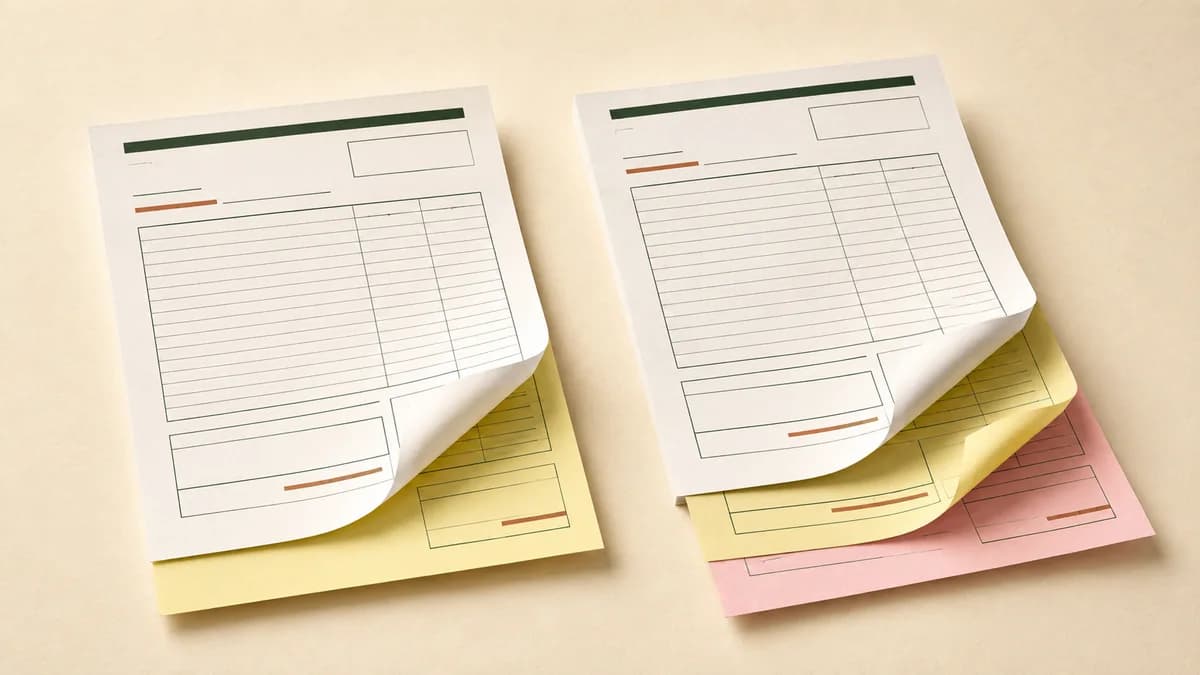
NCR means “No Carbon Required.” These carbonless forms create copies as you write on the top sheet, without separate carbon paper. The number of parts describes the sheets in one set, not the number of finished sets in your order. Forest Printing’s NCR forms and packets service can review your blank layout and the specification you need quoted.
Map the copies before choosing the form
| Question | Two-part form | Three-part form |
|---|---|---|
| How many copies are in a set? | Two | Three |
| When does it fit? | Two recipients need a copy. | Three recipients need a copy. |
| Example workflow | Customer and office | Customer, field team and office |
These examples are starting points. Walk a blank form through your actual workflow before ordering. An extra copy is useful only if somebody needs it; too few copies can leave the office recreating information later.
Specify sets, fields and numbering
A request for 500 three-part sets means 500 completed forms, each with three sheets. Write “sets” in your quote request so that a sheet count cannot be mistaken for an order quantity. Confirm the size, number of parts, quantities and any binding or finishing in the quote.
- Fields: Check that descriptions, quantities, authorizations and notes have enough writing space for the actual job.
- Copy destinations: Identify who receives each part and confirm any labels you want printed on it.
- Numbering: If you need consecutive numbers, provide the starting number and confirm where it should appear.
- Finishing: Describe how the team will carry, separate and store the forms; ask which finishing options fit that use.
Test the layout with the people who use it
Print a blank layout at its intended size and have staff walk through an example without entering real customer information. Check writing space, reading order and which sections each recipient needs. A layout proof checks the proposed artwork; confirm separately whether a physical sample is needed to assess writing or copy transfer.
For a reorder, supply the previous job reference or a blank approved version, then identify every change. “Same as last time” can conceal an old phone number, a revised authorization field or a numbering sequence that has already been used.
Choose a format that fits the working day
A front counter, a clipboard in a service vehicle and an office job file handle paperwork differently. Tell the shop where the forms will be used and whether you need loose sets, pads or books. Confirm the available finishing and writing-shield options, and check that the lowest copy remains readable in a physical sample.
Common questions about NCR forms
Does a three-part order include three finished forms per set?
It includes three sheets that record the same entry. An order of 500 three-part sets contains 500 usable sets, or 1,500 sheets. Specify the order in sets.
Who keeps each copy?
Your workflow decides. A service business might route copies to the customer, technician and office. Confirm the copy order and labels before the form is printed.
What should I send for an estimate?
Send a blank form or artwork file, the finished size, part count, quantity in sets and requested date. Include numbering and finishing requirements. If you need help with the layout, list the fields and explain how the form moves through the business.
What to send for a quote
Provide the blank layout, finished size, two or three parts, number of sets, numbering requirements, finishing and requested handoff date. The shop can then confirm the specification, proof, price and production availability for that order.
Request a print quote. If the forms will travel with an outgoing or return envelope, use the envelope preparation checklist to specify that item separately.