
Plan the booth before the print list
Work from the actual event space and organizer’s requirements. Identify where the company name must be visible, where conversations will happen and where visitors will pick up information. Measure the display positions before artwork is sized.
A reusable stand or frame may already determine the graphic dimensions. Check its specifications rather than estimating from a photograph. Hanging displays, floor graphics and other installations need their own material and venue review.
Separate three kinds of material
- Identification: the sign or display that helps visitors recognize the business and its offer.
- Conversation aids: a product sheet, diagram or sample used while someone speaks with the team.
- Take-home pieces: the information a visitor can carry away and use to make contact later.
A large display should not contain the whole brochure. Give the main message room and test it from the position where visitors will see it. Keep detailed specifications in a piece designed to be read up close.
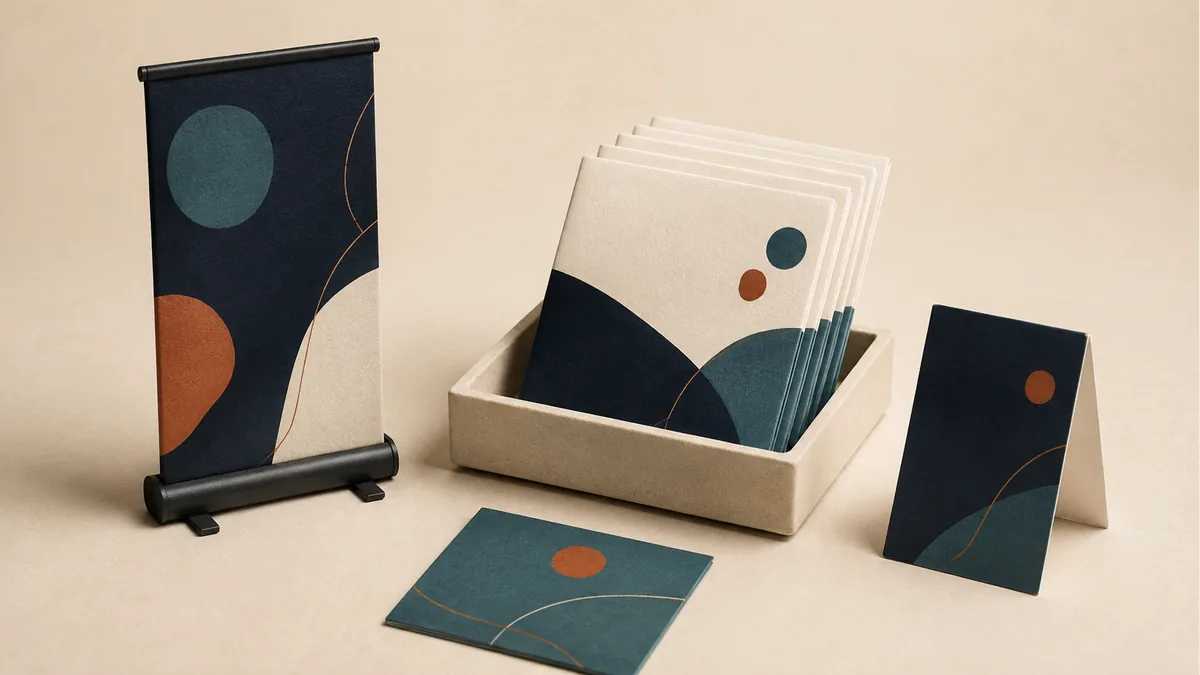
For large-format displays or event banners, provide the dimensions, material or hardware requirements and intended mounting. Confirm who supplies the stand, installs the graphic and handles any venue requirements.
Proof the kit as a group
Lay the designs out together. Check that the company identity, product names and contact details agree across the display and handouts. Each piece can have a different amount of information without becoming a different version of the business.
Read a printout at the intended size and test any QR destination. Ask what physical proof or sample is appropriate for color-sensitive or material-dependent work. Do not treat a readable screen preview as proof that a large sign will work from the aisle.
Put logistics beside the production date
Record the date the material must be available for packing, shipping or setup. That may be earlier than the first day of the show. Confirm the actual delivery location, receiving arrangements and installation responsibilities with the relevant provider.
Budget for the whole event, including the space, travel, staffing and logistics that apply. Use actual quotes for the print kit rather than treating a preset list of banners and giveaway quantities as the right package for every exhibitor.
Keep what will be useful next time
Count remaining handouts and inspect reusable displays after the event. Record the hardware, graphic dimensions and storage instructions with the artwork. Keep items protected according to their actual material and supplier guidance.
Review the inquiries and follow-up separately from foot traffic or compliments. Note which materials the team used in real conversations and which stayed in the box. Those observations give the next print list a better starting point than automatically ordering the same quantities again.